



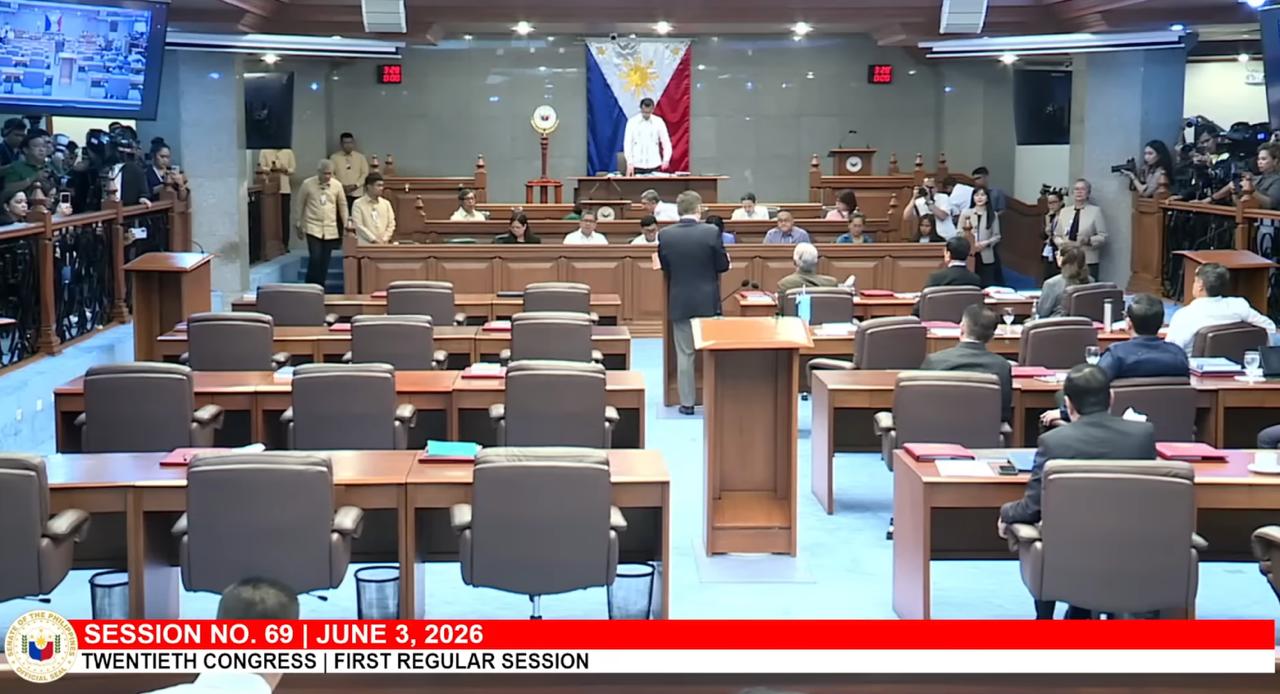

Tama ang bagong Senate majority sa paggamit ng 12-senator quorum noong June 3.
Ito ang punto ng magkahiwalay na pahayag ng Integrated Bar of the Philippines (IBP) at grupo ng law deans, law professors, professors of juridical science, at political theorists matapos kuwestiyunin ang Senate session kung saan 12 senador ang dumalo at itinuloy ang official business ng Senado.
Sa statement noong June 4, sinabi ng IBP na valid ang session batay sa Avelino doctrine, ang 1949 Supreme Court ruling sa Avelino v. Cuenco.
“In short, the Senate session of June 3, 2026 was lawful and valid following the Avelino doctrine because a quorum of 12 Senators was constituted,” ayon sa IBP.
“All acts, resolutions and decisions made by the Senate during its session of June 3, 2026 are presumed to be official acts of the Philippine Senate following the presumption of regularity in the discharge of official functions,” dagdag nito.
Umiikot ang isyu sa tanong kung may quorum ba kahit 12 lang ang pisikal na dumalo sa session.
Ayon sa IBP, oo. Hindi raw dapat isama sa bilang ang dalawang senador na hindi talaga mapapadalo. Ang isa ay detained kaugnay ng non-bailable offense, habang ang isa ay hindi matagpuan at hindi alam ang whereabouts mula May 11, 2026.
“Therefore, these two (2) senators are considered as beyond the reach of the Senate and cannot be compelled to attend its sessions,” ayon sa IBP.
Dahil dito, 22 senador lang ang itinuring na available. Majority na ang 12.
“With their exclusion, the total number of Senators considered available was twenty-two (22). Twelve (12) Senators therefore constituted a majority of those available, and thus a valid quorum was constituted for the Senate to conduct official business,” saad ng IBP.
Ginamit ng IBP ang Article VI, Section 16 (2) ng 1987 Constitution, na nagsasabing: “A majority of each House shall constitute a quorum to do business, but a smaller number may adjourn from day to day and may compel the attendance of absent Members in such manner, and under such penalties, as such House may provide.”
Pero mas binigyang-diin ng IBP ang Avelino ruling, kung saan ipinaliwanag ng Supreme Court na hindi laging nangangahulugan ang “House” ng lahat ng miyembro.
“There is a difference between a majority of ‘all the members of the House’ and a majority of ‘the House’, the latter requiring less number than the first,” bahagi ng ruling na sinipi ng IBP.
Ayon sa IBP, practical ang approach ng Avelino doctrine. Dapat basahin ang Constitution sa paraang hindi mapaparalisa ang Senado dahil sa mga miyembrong hindi mapilit na dumalo.
“This Avelino ruling emphasizes a practical approach: the Constitution should be interpreted in a way that allows the Senate to function, and not be blocked by the absence of Members who cannot realistically be made to attend,” ayon sa IBP.
Pareho ang direksyon ng pahayag ng mga law deans at legal scholars.
“Our people are confused – and they are weary of the incessant wrangling that threatens the credibility of an institution essential to the workings of our democracy,” ayon sa grupo.
Sinabi nilang nagbibigay-linaw sila sa gulo.
“We consider it our obligation as professors of law and the juridical sciences to lend whatever clarity we can to a muddled situation. We will do so in as direct a manner as possible,” dagdag nila.
Para sa kanila, hindi dapat mabilang si Sen. Ronald “Bato” de la Rosa sa quorum dahil nagtatago ito at hindi alam ang kinaroroonan. Hindi rin raw makadalo si Sen. Jinggoy Estrada dahil detained ito.
“To insist that he should be counted in determining a majority for purposes of quorum is to accord someone who is evading arrest and the processes of law, and deliberately putting himself beyond the reach of any legal coercion, the power to hold the entire legislature hostage,” ayon sa statement.